Southwestern OntarioServing Canada & U.S.
HomeComponentsCapacitance Level Sensors
High / low alarms • Capacitive probes • Bulk solids & liquids

Capacitance Level Sensors

Find capacitance point-level sensors for material detection in bins, silos, hoppers, chutes and process vessels. Capacitive probes help detect when powders, pellets, granules or liquids reach a designated position, supporting high-level alarms, low-level notifications and process interlocks. We coordinate replacement and new-equipment inquiries using your material and installation details.

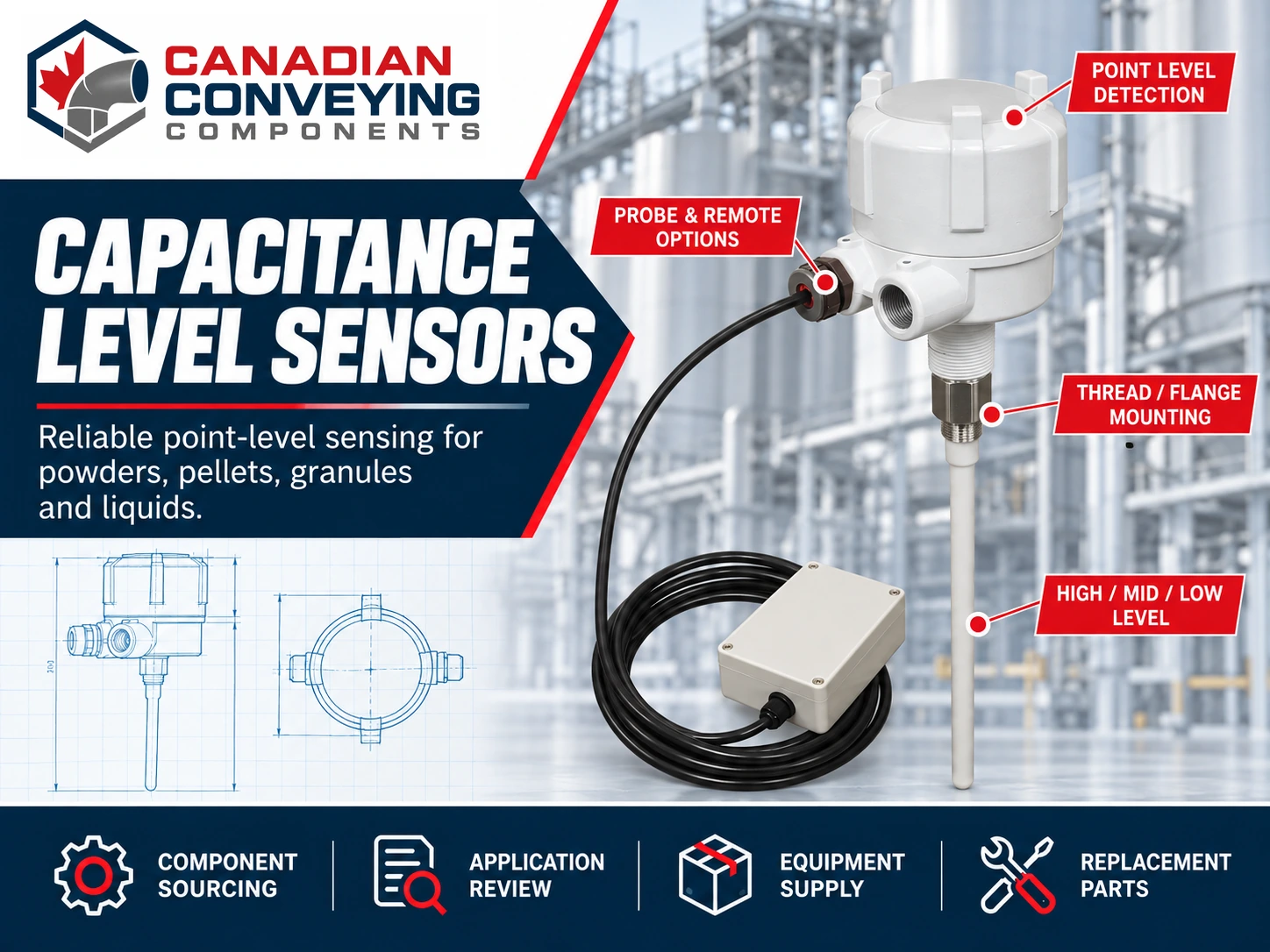
Supplier-neutral capacitance point-level sensor with a probe, threaded vessel connection and representative remote electronics

Illustrative sensor configuration. Probe material, electronics arrangement, thread or flange, electrical output, ratings and suitability are confirmed with the selected supplier.

Capacitive level sensor sourcing

The appropriate sensor depends on what is being detected, where it is mounted and how the signal is used. We help collect the application details needed to request an accurate supplier quotation.

Equipment options

We can coordinate inquiries for:

  • Standard and compact capacitance point-level probes
  • Rigid rod, shielded, flush-mount and flexible probe arrangements where available
  • Integrated or remote electronics, replacement sensing elements and mounting accessories

Typical applications

Common uses include:

  • High-level alarms in silos, hoppers and bins
  • Low-level detection to signal replenishment or prevent running empty
  • Point detection in powder, pellet, granular and compatible liquid processes

Information for a quotation

Helpful details include:

  • Material type, bulk density, coating/buildup, moisture and temperature
  • Probe length, insertion direction, vessel wall or nozzle details and mounting size
  • Available power, required contact/PLC signal, hazardous-area needs and quantity

How capacitive point-level sensing works

Capacitance instruments detect a change in electrical properties around a sensing probe when material is present, rather than measuring a continuous product height in the usual point-switch configuration.

A probe detects at one installed elevationCapacitance point-level sensor mounted through vessel wall at one detection elevationSENSING POINTSENSOR HEADSWITCH SIGNALMATERIAL LEVEL

Conceptual point-level sensing. Actual sensitivity and installation require supplier verification.

Detecting material presence

The probe and its surrounding reference form a capacitive sensing arrangement. When material replaces air around the probe, the effective dielectric environment changes. Sensor electronics use that change to identify a covered or uncovered condition.

High, mid or low points

A sensor can be located at an appropriate vessel elevation, subject to the probe design and installation. Different mounting positions provide separate point indications, not an automatic continuous level reading from a single probe.

Connecting to controls

Depending on the unit selected, a switching output can be used for alarms or connected to plant controls. Supply voltage, contact rating, output type and fail-safe behaviour must be matched to the actual system.

Have a part to source? Provide the existing model or photos and the material, probe location, connection and required output.

Request sensor pricing →

Key selection & replacement considerations

Choosing a suitable capacitive probe involves more than matching its physical length.

Materials & buildup

Material dielectric properties, deposits on the sensor, dust, moisture and changes in operating conditions can affect sensing. Ask suppliers about sensitivity adjustment, probe shielding and suitability for buildup-prone applications.

Probe construction & mounting

Check rod versus flexible probes, insulated or bare sensing elements, chemical and abrasion resistance, insertion depth, process pressure, temperature, thread or flange configuration and vessel geometry.

Electrical & safety requirements

Confirm electrical ratings, relay or other switching output, alarm philosophy, environmental protection, any applicable explosion/hazardous-location approvals and installation responsibilities with the supplier and qualified plant personnel.

Request a capacitance sensor quotation.

Start with the nameplate or model of your existing sensor, a photo and a description of the material. For new applications, send a simple sketch showing the desired detection point and probe mounting arrangement.

Existing brand/model or a photo of the sensor and connection
Material being sensed, buildup tendency and operating temperature
Probe insertion length, connection size and detection location
Electrical supply, required control output, quantity and delivery location

Related products & resources

Compare sensing technologies and adjacent material-handling equipment.

Frequently asked questions

Common questions about capacitive level switches and replacement selection.

Does a capacitance sensor measure the entire silo level?

A typical capacitance point-level switch indicates when material is present at its probe location. It does not provide a continuous measurement of fill height. Multiple switches may be used at different elevations; other level-measurement technologies are available for continuous monitoring.

How is a capacitance probe different from a rotary paddle switch?

Capacitance probes sense changes in electrical capacitance around the probe. Rotary paddle indicators use a turning paddle whose movement is interrupted by material. Selection depends on the bulk material, buildup tendency, available space and operating conditions.

Can capacitive probes detect powders, pellets and liquids?

Potentially, yes. Suitability varies with the material's dielectric properties, conductivity, tendency to coat the probe and the sensor's design. The supplier should verify performance for the particular application.

Can I replace my existing sensor with another manufacturer's model?

Some alternatives may be available, but check mechanical connections, sensing characteristics, probe dimensions, power supply, output contacts, environmental ratings and any hazardous-area approvals before approving a substitute.

When are remote electronics useful?

Some systems separate the electronics from the sensing probe, which can help with limited access, temperature or vibration at the mounting location. Cable length and component compatibility depend on the equipment selected.