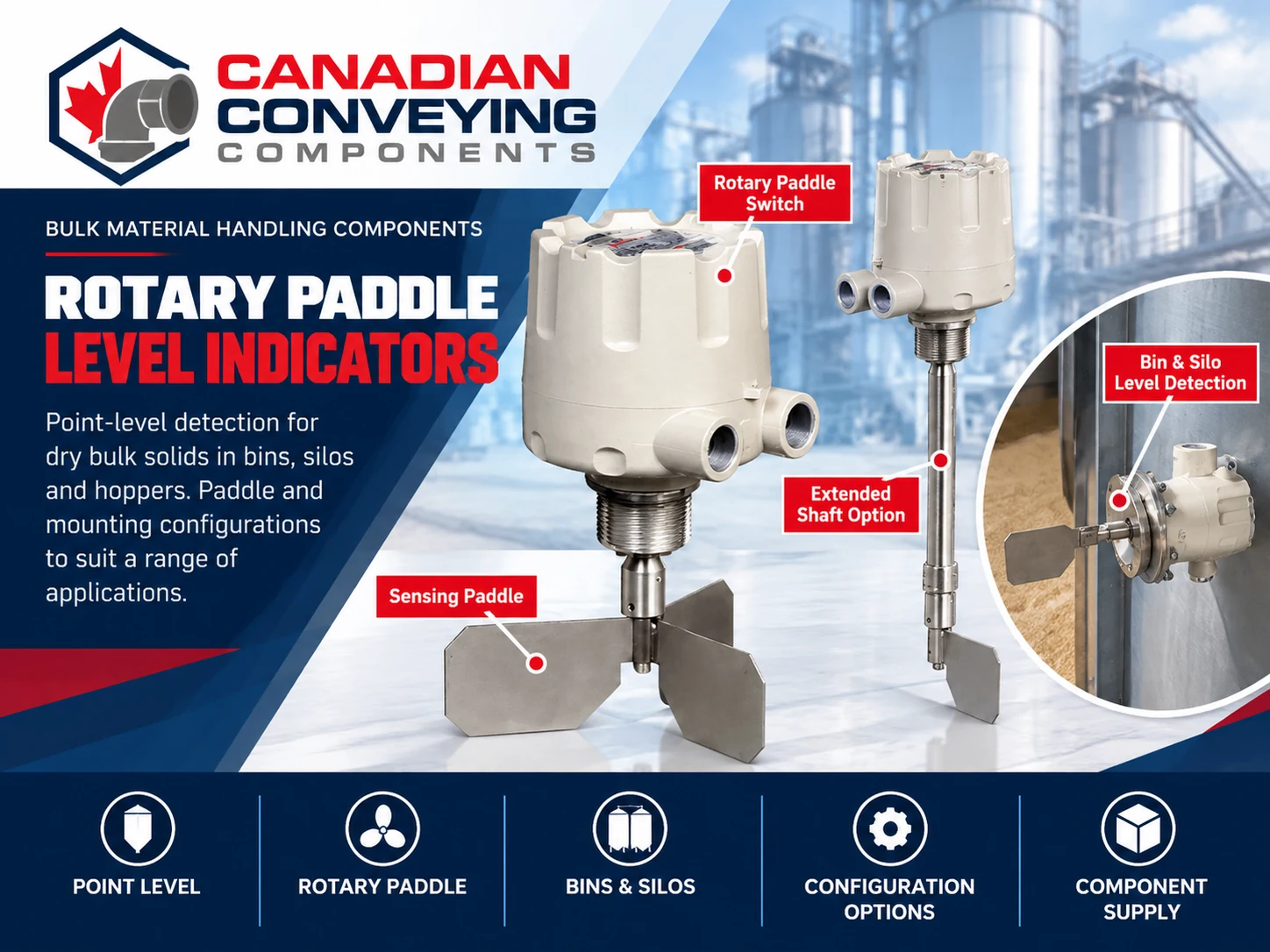
Rotary paddle level indicators for bins, silos & hoppers.
Canadian Conveying sources rotary paddle point-level switches for dry bulk materials. These electromechanical indicators are commonly used to identify when material reaches a selected high- or low-level position in bins, silos and hoppers. Send a photo, mounting dimensions or your existing switch information to request replacement or new-installation options.
Representative rotary paddle switch configurations. Dimensions, materials, ratings and suitability are confirmed during quotation.
POINT-LEVEL SENSING FOR DRY BULK MATERIALS
A straightforward way to detect material at a set level.
A motor-driven paddle rotates when it is clear of material. When bulk solids cover the paddle and restrict its movement, the switch responds to indicate material at the installed elevation. Rotary paddles are generally used for point-level detection, not continuous measurement of the amount stored in a vessel.
For a useful first quotation
Provide material type and approximate bulk density, operating temperature, vessel pressure or vacuum, mounting location and connection dimensions, shaft length, power supply and the preferred electrical output or existing model. Photos of the installed switch are especially helpful.
Final selection depends on material flow characteristics, buildup, mechanical loading, electrical and environmental ratings, and any hazardous-area requirements. Manufacturer data and applicable certifications must be confirmed before ordering.
Representative configurations, subject to supplier capability and application suitability.
Point-level detection at the installed elevation
Conceptual illustration; mounting, contacts and suitability depend on the specified switch.
Standard rotary paddle switches
Point-level indicators for dry bulk solids in storage bins, feed hoppers and silos, where a suitable mounting point and paddle geometry are available.
Extended-shaft indicators
Longer shaft arrangements for reaching the required detection elevation. Shaft support, orientation and permissible loading require review.
Replacement & mounting options
Paddle styles, mounting adapters, connections and electrical specifications selected to suit the vessel and any existing installation.
Have a part to source?An existing model, photo, mounting detail or application description is enough to begin.Request a level switch quote →
WHAT TO INCLUDE IN YOUR REQUEST
Details that help identify the right level switch
Providing the application details up front makes it easier to match a replacement or review alternatives without relying on appearance alone.
Material & flow behaviourPowder, pellets or granules; approximate bulk density; buildup, abrasion, bridging or unusual flow conditions.
Location & mountingHigh or low level; side or top mounting; nozzle size, mounting thread or flange, insertion depth and any shaft extension.
Electrical & controlsSupply voltage and frequency, switch/contact requirements, enclosure rating, cable entry and any existing controller interface.
Service conditionsOperating temperature, pressure or vacuum, weather/washdown exposure, required material compatibility and hazardous-area classification where relevant.
Alarm and control applications: If the switch is used for overfill prevention, process interlocking or an alarm, include the intended normal/fault contact state and what should happen on loss of power. The switch and installation must be reviewed for the required safety function and any dust-hazardous-area classification.
Request a rotary paddle level indicator quote
Tell us what you know about the existing switch or vessel. We'll use the information to seek suitable supplier options.