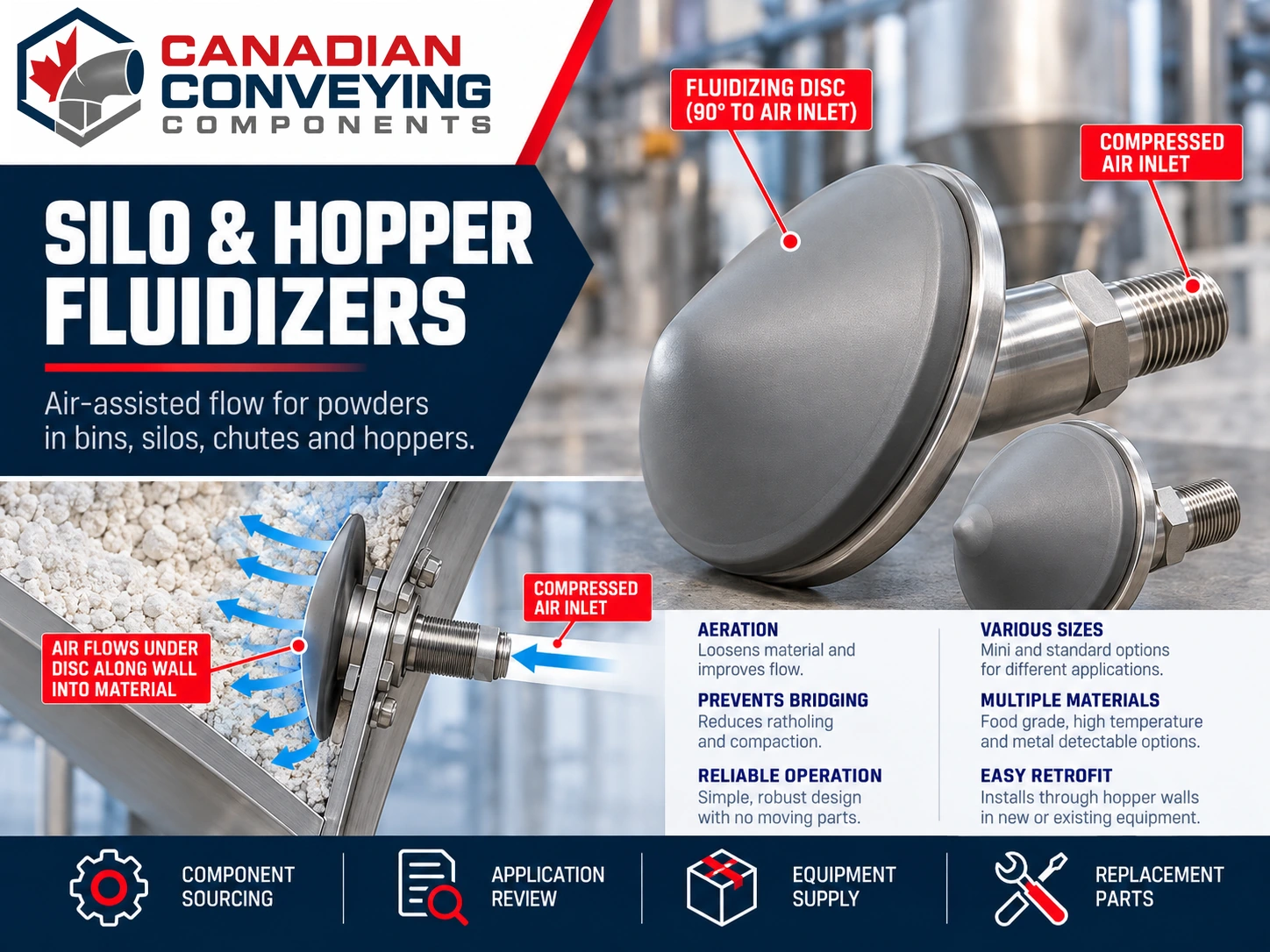
Source pneumatic fluidizing disks and aeration flow aids for dry bulk material in storage bins, silos, hoppers and chutes. Mini and standard disk-style fluidizers can help loosen cohesive material near vessel walls and encourage more consistent discharge when correctly selected and installed.
Representative equipment illustration. Final disk material, size, air requirements, mounting arrangement and material suitability are confirmed by the selected supplier.
Fluidizer sourcing & equipment options
Pneumatic fluidizers help promote the flow of suitable powders through local aeration at the bin wall. The right selection depends on material characteristics, hopper geometry and available air supply.
Equipment options
We can coordinate inquiries for:
Compact mini fluidizing disks for small hoppers, chutes and confined locations
Standard-sized pneumatic disks for larger storage and discharge applications
Replacement disks, stems, fittings and related air-control accessories where available
Typical applications
Commonly considered for:
Dry powders that bridge, form ratholes or hang up near walls and corners
Silos, hoppers, chutes and small-diameter transfer points
Existing installations where controlled aeration may help improve material drawdown
Details for a supplier quote
Helpful starting information:
Product handled, bulk density, moisture, temperature and flow characteristics
Vessel dimensions, hopper slope, wall material and available mounting locations
Existing disk/stem details, available compressed air and required quantity
How pneumatic fluidizing disks work
A fluidizer works differently from a bolted-on mechanical vibrator or a complete vibrating discharge assembly.
Air-assisted flow at the hopper wall
Conceptual disk-style installation; final placement and air requirements are supplier-specific.
Disk inside, inlet outside
A flexible disk sits against the inside hopper wall. Its threaded air connection passes through the wall so the compressed-air supply connects from the outside. The disk face is generally perpendicular to the inlet stem.
Air travels along the wall
During operation, air reaches the underside of the disk and passes beneath its edge into the material, helping loosen powder along the hopper wall. The exact airflow pattern depends on the supplier design, air conditions and installation.
Flow aid—not a feeder
Fluidizers are intended to assist discharge of suitable bulk solids. They do not independently meter product at a set rate, and they are not a guaranteed cure for unsuitable hopper geometry or every cohesive material.
Have a part to source?Send a photo, part number or description — you don't need a complete specification to start.Start a quotation →
Selecting the right installation
Disk size, material compatibility, air supply and placement should be confirmed for each installation rather than copied from a different vessel.
Size & placement
Small or tight-curvature vessels may require compact disks. Larger hoppers may require multiple locations. Supplier guidance should establish disk spacing, operating method and any vessel modifications.
Material & air compatibility
Ask about elastomer selection, process temperature, abrasion, chemical exposure, sanitation needs and any food-contact documentation. Also confirm clean, appropriate air supply pressure and flow.
Installation & safety
Confirm mounting-hole dimensions, wall access, isolation valves, controls and maintenance access. Vessel alterations, pressure safety and combustible-dust considerations require review by qualified parties.
Process and dust safety: Introducing compressed air changes the gas flow inside a vessel. The suitability of air-assisted fluidization, air quality, controls, venting and any combustible-dust or inert-atmosphere requirements must be reviewed for the specific material and installation. A fluidizer is a flow aid, not an explosion-protection device.
Request a fluidizer or replacement quotation.
Describe the powder, identify the flow problem and send a photograph or drawing of the hopper and mounting area. If replacing an existing fluidizer, include its disk diameter, threaded stem and air fitting details if known.
Hopper or silo photos, dimensions and flow-problem location
Material handled, moisture, temperature and bulk density
Disk or stem dimensions, existing model, quantity and control method
Available compressed air, delivery location and required timing
Key distinctions when evaluating pneumatic flow aids for bins, hoppers and silos.
What is the difference between a fluidizer and a bin vibrator?
A fluidizer uses air released along the inside of a bin or hopper wall to encourage suitable powders to move. An external bin vibrator attaches to the structure and transmits mechanical vibration into it. Different materials and vessels may respond better to different flow aids.
Does a fluidizer spray air directly out of its front face?
For the flexible disk-style units shown here, the disk rests against the internal wall. Air arrives through a fitting from outside and travels beneath the flexible disk edge along the inside wall into the material, rather than through an open forward-facing nozzle.
Are mini and standard fluidizers interchangeable?
Not necessarily. Disk diameter, stem dimensions, mounting holes and air requirements can differ. A compact unit may be suitable for smaller or tighter sections, but suitability and installation details must be confirmed with the supplier.
Can a fluidizer help with bridging or ratholing?
It may help with some dry bulk materials and hopper geometries, but performance depends on the product properties, vessel design, fluidizer placement and operating method. A supplier should review the application before an equipment selection is approved.
Can fluidizers be retrofitted to an existing silo or hopper?
Some installations allow retrofit through the vessel wall, but structural integrity, mounting details, air controls, safety isolation and any food-contact or hazardous-area requirements must be assessed for the actual site.