Southwestern OntarioServing Canada & U.S.
HomeComponentsSpiral Ductwork & Fittings
Dust collection • ventilation • process air

Spiral Ductwork & Fittings

Source spiral-seam duct pipe, elbows, reducers, branches, take-offs and related fittings for industrial ventilation, dust collection and suitable process-air systems. Share your diameter, wall thickness or gauge, material, connection details and operating duty so suppliers can confirm compatible components.

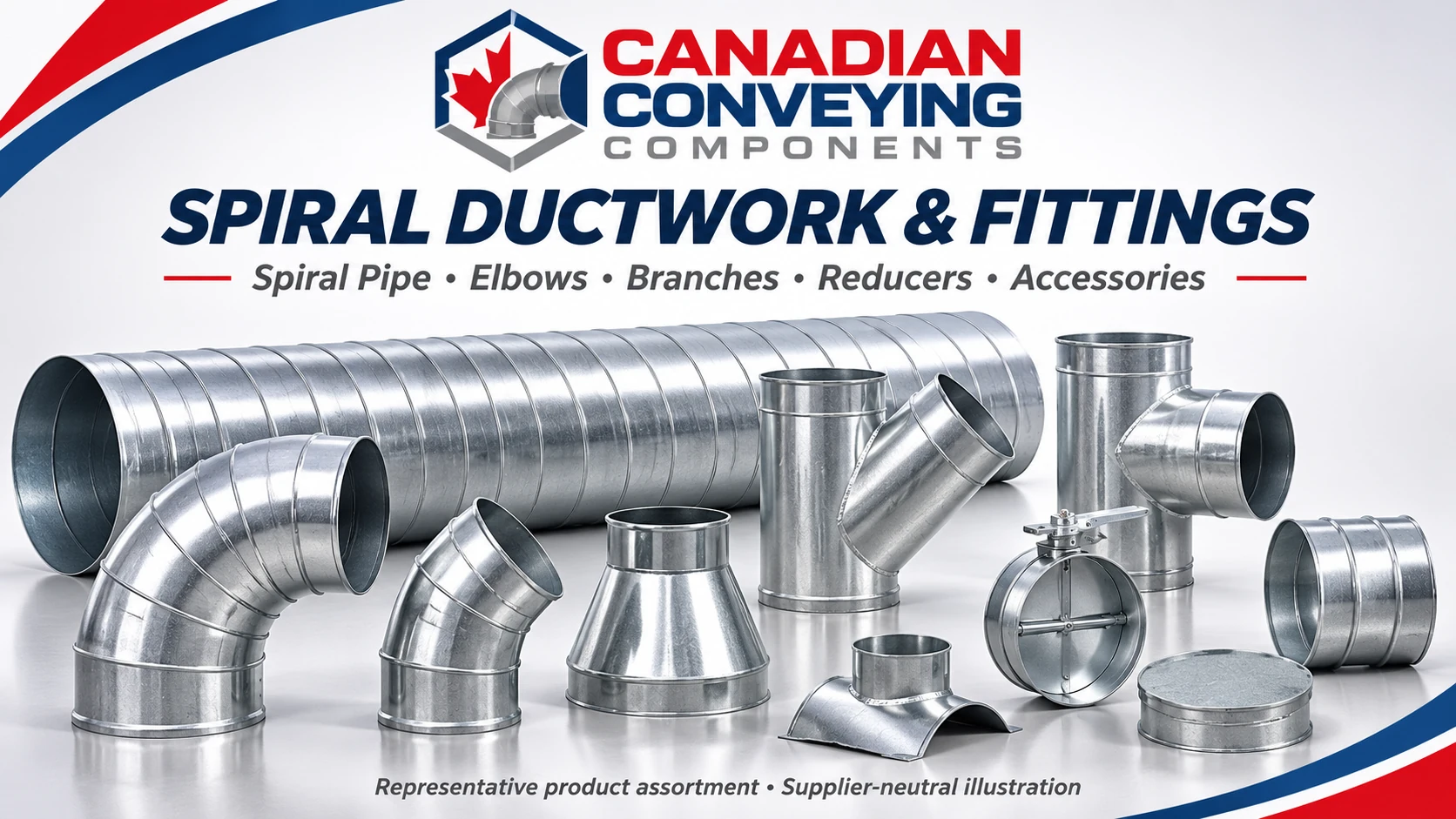
Canadian Conveying supplier-neutral illustration of galvanized spiral ductwork, elbows, reducers, branches, dampers and fittings

Representative spiral ductwork and fittings. Final dimensions, joint styles and suitability are confirmed at quotation.

Spiral ductwork and fittings we can help source

Spiral duct is used across many air-handling applications, but wall construction, connection style, sealing and service limits must match the actual system.

Common components

Supplier-supported options may include:

  • Spiral-seam straight duct lengths in specified diameters, materials and gauges
  • Elbows, reducers, branches, tees, take-offs and custom transitions
  • Connectors, clamps, flanges, access fittings and suitable dampers

Typical applications

Depending on the construction and system design:

  • Industrial dust collection and extraction ductwork
  • Ventilation, exhaust and general process-air distribution
  • Connecting fans, filters, separators and air-handling equipment

Send with your inquiry

These details help suppliers quote accurately:

  • Nominal size and actual connection diameter; gauge or wall thickness
  • Galvanized, stainless or other material; fitting lengths and quantities
  • Joint type, drawings, operating pressure/vacuum and service conditions

Confirm the system before matching the duct

Diameter alone is not enough to establish whether replacement duct and fittings will fit—or perform safely under your operating conditions.

Diameter & construction

Specify the actual duct diameter, sheet material, gauge or wall thickness, straight-section lengths and fitting centreline dimensions. Identify whether the system follows an established duct standard or original manufacturer specification.

Connection & sealing

Describe slip connections, clamps, flanges, welded joints or other end styles. For replacements, send photos and measure mating fittings; leakage requirements and gasket selection should be verified against the full assembly.

Operating duty & material

Identify airflow, pressure or vacuum, temperature, dust loading and material abrasiveness. Grounding, combustible dust, corrosive exhaust or high-pressure service may require special materials, design or approvals.

Spiral ductwork vs. pneumatic conveying pipe

These are related but not interchangeable product categories. Ordinary spiral-seam ventilation duct should not be assumed suitable for material-laden pneumatic conveying or higher pressure duty.

Ventilation & dust extraction

Spiral-seam duct may suit air movement and properly designed dust-extraction systems when pressure, abrasion, joints and required containment are addressed by the designer and manufacturer.

Pneumatic material conveying

Conveying pipework is selected for solids loading, velocity, wear, operating pressure or vacuum, connections and process safety. Review our conveying pipe and coupling options for that duty.

Request a spiral ductwork quotation.

A duct schedule or sketch is the best starting point. If matching an existing system, send photos of the installed joints and record actual connection dimensions.

Duct diameters, wall thickness or gauge, and material
Elbows, reducers, branches and fitting dimensions
Joint style, leakage or pressure duty and application
Lengths, quantities, timing and delivery destination

Frequently asked questions

Common purchasing questions for spiral duct pipe and industrial fittings.

Can spiral ductwork be used for pneumatic conveying?

Do not assume that standard spiral-seam ventilation duct is suitable for transporting bulk solids. Pressure or vacuum, conveyed material, wear, seam construction and connection integrity must be reviewed for the actual application; purpose-built conveying pipe may be required.

What sizes and gauges can you quote?

Availability depends on the selected manufacturer and material. Share nominal and measured diameter, gauge or wall thickness, desired lengths and quantity for supplier confirmation.

Can fittings connect to our existing duct system?

Often there are possible options, but matching nominal diameters does not establish a correct fit. Connection profiles, end dimensions, seals and available space should be confirmed with the supplier.

Can you quote a ductwork bill of materials?

Yes. Send a schedule or marked-up drawing showing straight lengths, elbows, reducers, branches, dampers, connection hardware, materials, quantities and delivery destination.