Equipment types
Inquiries may include:
- Industrial cyclone separators for particulate-laden airflow
- Pre-separation stages ahead of filters or dust collectors
- Application-matched bodies, discharge connections and wear-resistant construction
Source industrial cyclone separators and pre-separators for dust-laden air streams. We help coordinate supplier quotations using your airflow, material characteristics, inlet and outlet connections, pressure-loss requirements and available installation space.
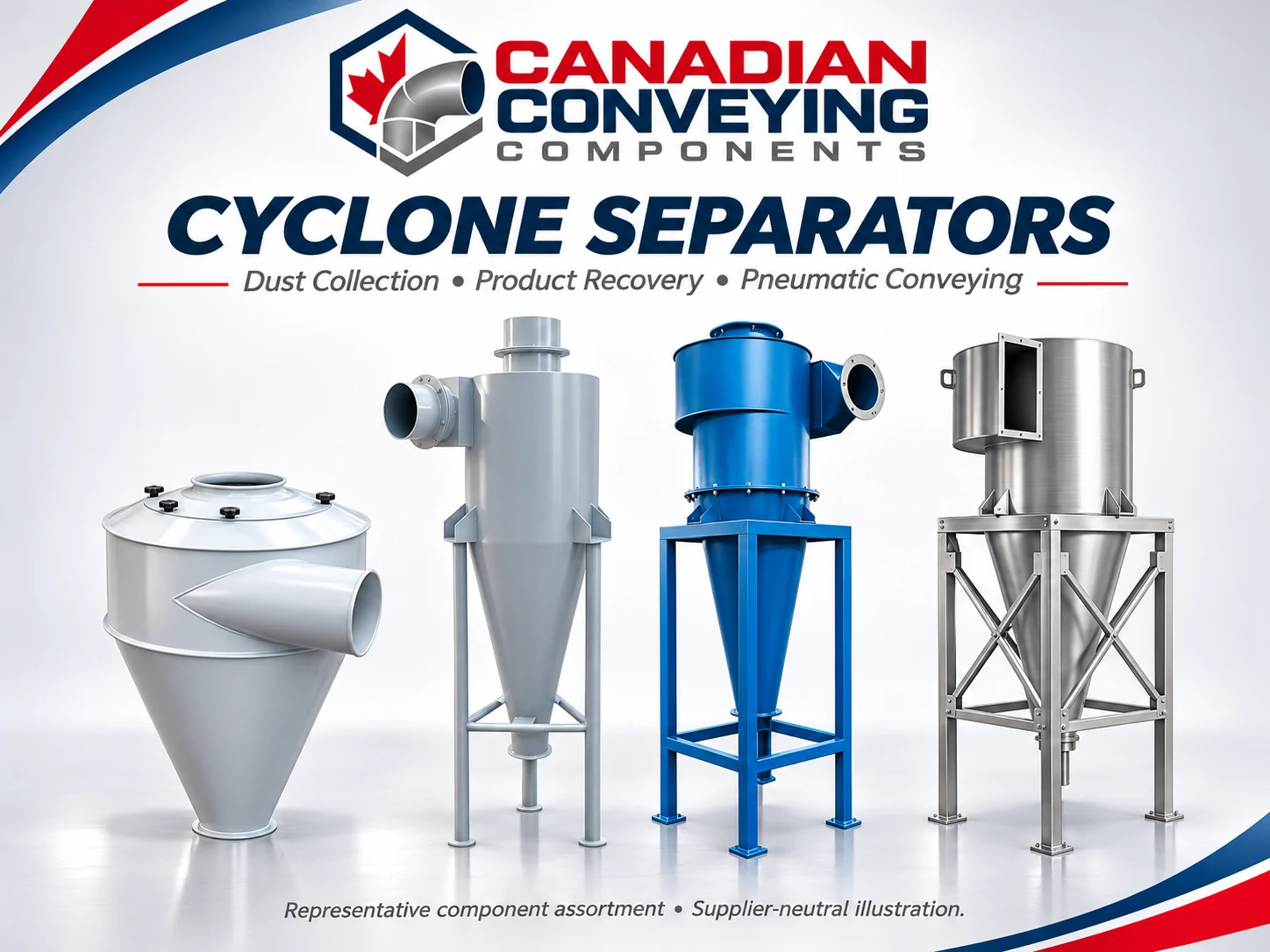
Illustrative cyclone configurations. Final geometry, efficiency, pressure drop and connections are confirmed for your operating duty.
Cyclones are selected around a defined air and particulate duty. Supplier performance information is needed to assess whether a proposed unit meets the required separation and pressure-loss objectives.
Send its dimensions, inlet/outlet and discharge connections, current airflow and any performance issues.
Send air volume, dust loading, particle characteristics, allowed pressure drop, space and discharge needs.
Cyclone performance depends on the specific gas, particle size distribution and operating conditions. An appropriately sized cyclone may reduce dust loading upstream of other equipment but will not provide the same collection performance as a final filter.
Conceptual airflow, not a performance rating. Separation and pressure loss require supplier data.
Provide normal and maximum volumetric airflow, available fan pressure, temperature and any restrictions on added system resistance. Pressure loss must be checked using manufacturer data.
Dust loading, density, particle-size distribution and abrasiveness affect selection. Request documented performance and abrasion protection where the duty requires them.
Confirm hopper or rotary airlock connection, support and maintenance access, clearances and available height. Combustible-dust applications require a separate hazard and protection review.
Have a part to source? Flow rate, dust characteristics, inlet/outlet sizes and available pressure drop are the most helpful starting points.
Request cyclone pricing →Send your design airflow, dust or material details, existing cyclone drawings or dimensions, allowable pressure drop and desired discharge connection. Supplier separation performance must be confirmed for the proposed operating conditions.
Explore adjacent product categories and supporting resources.